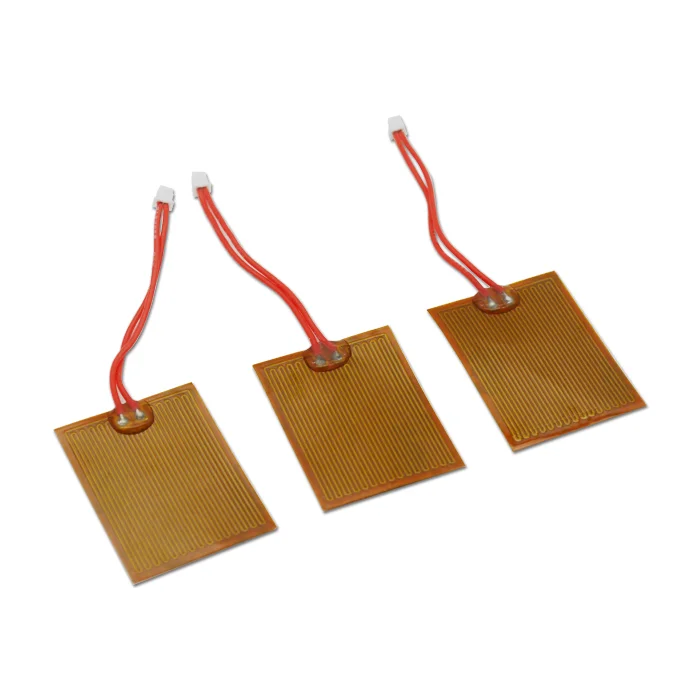
KHEAT-PI Film Heating Element
- Dielectric Breakdown Voltage
- ≥1000VAC/MIN
- Max Power Density
- 1.0W/cm²
- Recommended Power Density
- 0.1-0.6W/cm²
- Thickness
- 0.1~0.52mmT
- Continuous Use Temp
- 200°C (it depends on temperature stabil…
- Continuous Use Temp
- −40 to 130 °C
KHEAT-PI — Product overview
Kheat PI-Polyimide(kapton) heater is a heating material developed and produced independently by Ziitek company. The product is very soft, using modified PI film for better thermal conductive performance. It can be customized according to design requirements, so that it can meet the requirements of different heating power and temperature distribution in different areas of parts.
KHEAT-PI — Features
Thickness of resistor
Ultra soft, the smallest bending radius is 0.8mmT
The product uses modified PI film for better thermal conductive performance, made of tw…
Can be customized according to shape, size, power, way of installation; the products ar…
The resistor is etched with the designed pattern, has better heating uniformity
Can be easily integrated with thin insulation materials, providing lightweight electric…
Application engineering
Specifying a polyimide heater for a thermal test vehicle
A thermal test vehicle (TTV) uses a controlled heat source to evaluate a cooling assembly. A custom KHEAT-PI heater layout can be evaluated for the required active area, mounting surface and electrical supply; temperature uniformity must be measured on the assembled fixture.
- Heater circuit
- Bonded contact
- Test-vehicle surface
- Cooling assembly
Define the active area
Distinguish the heated area from the overall film outline, lead exits and cutouts. Nominal average power density is electrical power divided by active heated area; it does not describe local hot spots or reproduce every chip power map.
Specify the electrical supply
Provide voltage, target power, control method and sensor location. Choose the heater circuit and mounting method together rather than treating a catalogue maximum as an operating recommendation.
Validate contact and temperature
Record the substrate, attachment method, ambient conditions, sensor positions and steady-state criterion. Check surface temperature distribution and repeatability with a defined measurement method. Confirm film and adhesive limits separately.
Bring these inputs to the design review
- Active heated area, overall outline and cutouts
- Supply voltage, target watts and power distribution
- Substrate, attachment method and cooling boundary
- Temperature target, sensor layout and uniformity criterion
The customer-confirmed TTV application brief specifies −40 to 130 °C for the published configuration, superseding the linked legacy PDF's temperature entries. Qualify the attachment and control conditions separately. This schematic is not a measured heat map; simulation temperatures are not product ratings.
Where this grade is used
Typical application targets for this grade include New energy industry (battery), Communication security industry, Video camera, hard disk video recorder, Power industry, military aerospace, All kinds of electronic products that need to be heated, Medical equipment, precision instruments and equipment.
KHEAT-PI — datasheet specifications
Values below are transcribed from the official datasheet (Customer-confirmed application brief, 2026-10-30; legacy PDF retained for reference). Use the linked PDF for sign-off and lot-specific CoA.
Request application engineering support| Parameter | Value (typical / as stated) |
|---|---|
| Operating Voltage | 1~220V AC/DC |
| Continuous Use Temp | −40 to 130 °C |
| Dielectric Breakdown Voltage | ≥1000VAC/MIN |
| Continuous Use Temp | −40 to 130 °C |
| Insulation Resistance (MΩ) | ≥100 |
| Thickness | 0.1~0.52mmT |
| Recommended Power Density | 0.1-0.6W/cm² |
| Mechanical Compression Strength | 100KG/cm² |
| Max Power Density | 1.0W/cm² |
| Pull Force of Guide Line | ≥80N |
| Service Life | 5~10 years |
| Pull Force of Soldering Point | ≥20N |
The customer-confirmed TTV application brief specifies an operating range of −40 to 130 °C. This supersedes the temperature entries in the linked legacy PDF for this published configuration. Confirm the selected attachment, adhesive and control conditions for qualification; other listed properties remain from the legacy datasheet.
Related kapton and polyimide heating films models
| Model | Power Density | Operating Temp | View |
|---|---|---|---|
| KHEAT-SP | 0.1-0.6W/cm² | 200°C (it depends on temperature stability of the adhesive if customer needs adhesive) | Details |
KHEAT-PI — common questions
Replacing another vendor's TIM or need a stack review? Send drawings — applications responds quickly.
Talk to an engineerWhat should be specified for a KHEAT-PI TTV heater?
Provide active heated area, total outline and cutouts, supply voltage, target electrical power, mounting surface, attachment method, sensor positions and the temperature-distribution criterion. Keep these requirements separate from the heater family's catalogue limits.
How is heater power density calculated?
Nominal average power density in W/cm² is total electrical power in watts divided by active heated area in cm². Exclude unheated borders and cutouts from that area. The average does not establish local peak temperature or surface uniformity.
Does a polyimide film heater guarantee a uniform TTV surface temperature?
No. Trace layout, contact, substrate, edge losses, control and cooling conditions affect the temperature field. Define the measurement locations and steady-state criterion, then verify the assembled fixture with calibrated measurements.
Which operating-temperature limit applies to a bonded KHEAT-PI heater?
The customer-confirmed TTV application brief specifies −40 to 130 °C for this published configuration, superseding the earlier PDF temperature entries. Film, adhesive and sensor limits must still be considered separately with the substrate and control conditions; request the current qualification revision.

Your next thermal solution starts here.
From rapid prototyping to full-scale production — our engineers are ready to design a custom thermal solution for your application. Trusted by 7,000+ clients across EV, 5G, and consumer electronics.